
Aspers Account: Registration, KYC and Safer Gambling Checks
Account guide
An Aspers account journey should be understood as more than filling in a sign-up form. Aspers requires account verification/KYC, while a fixed current list of Aspers documents and a promised verification time are not reliably verified. For a Great Britain customer, account onboarding also sits inside Gambling Commission rules that include financial-limit prompts and, at the relevant threshold, light-touch financial vulnerability checks.
The practical flow is therefore: confirm that you are eligible to use the current service, create the account using accurate personal details, complete any identity checks requested through the genuine account area, set or review financial controls before funding the account, and keep withdrawal and safer-gambling settings in mind from the start. This page explains those stages without inventing form fields, KYC paperwork or processing guarantees.
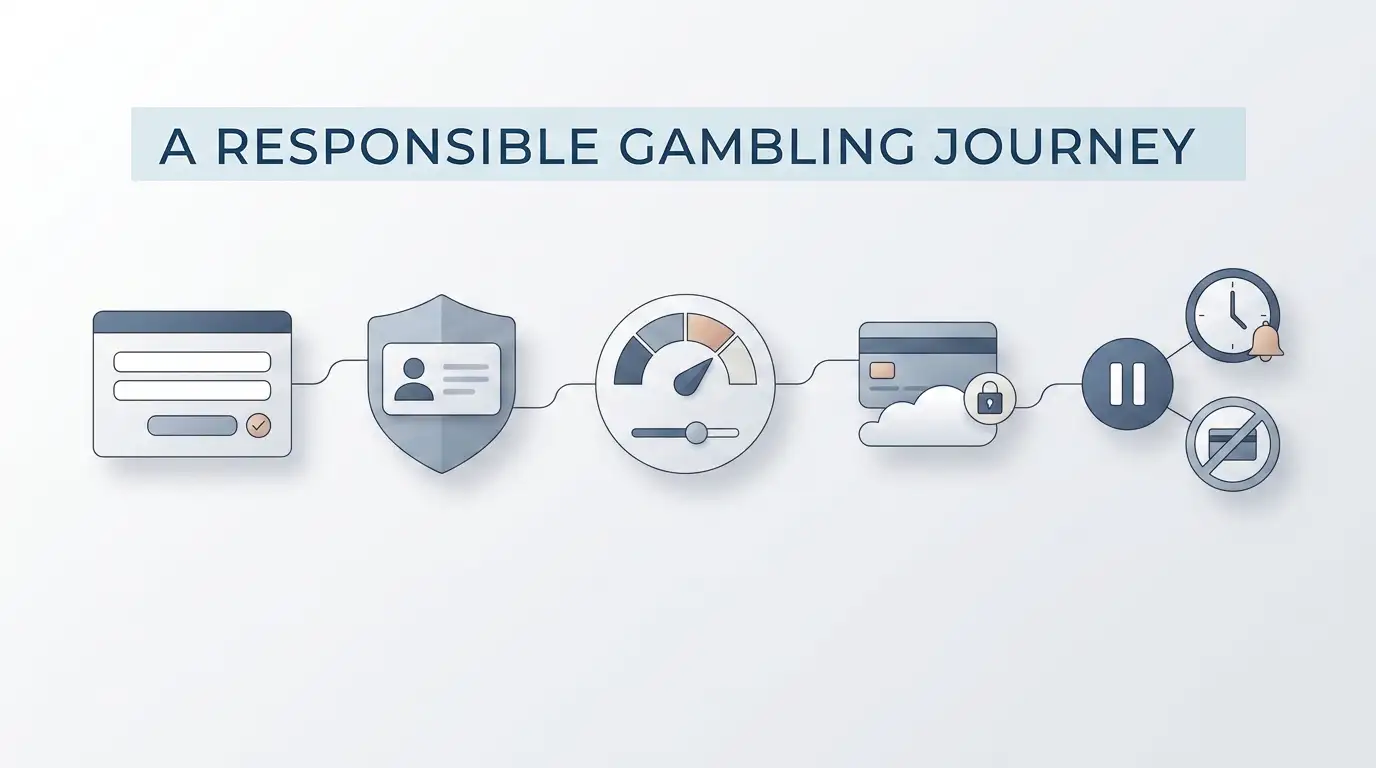
Aspers registration: the account flow in plain English
The most useful way to approach Aspers Casino registration is to think in stages rather than copy an old sign-up walkthrough. Registration interfaces change, and no reliable current source justifies claiming a particular sequence of fields, buttons or screens. What matters is the function of each stage.
- Check the current operator route. Start from a current, verified route rather than a link in an old review, message or download page. Operator-status checks are covered separately in the Aspers licence and trust.
- Enter accurate account information. Details used for registration need to be consistent with the information you can later verify. Deliberate mismatches can create avoidable problems when identity or payment checks are required.
- Complete account verification when requested. KYC/account verification is part of the Aspers account process. This guide does not state an exact document checklist because that exact list is not established in the information used for this guide.
- Review financial controls before depositing. For Great Britain-licensed remote operators, current rules require customers to be prompted to set a financial limit before their first deposit.
- Keep withdrawal readiness in mind. Identity and payment checks are easier to manage when account details are accurate from the start. The separate withdrawal guide explains the verified cash-out routes without inventing exact limits or processing promises.
What Aspers KYC means, and what this guide will not guess
Aspers requires account verification/KYC. KYC is the account-checking process used to establish that the customer and the account information can be verified. It can interact with age checks, identity checks, payment security and anti-fraud controls.
The distinction is important: verification is documented, but an exact Aspers document list and an exact verification time are not established well enough to publish as fixed requirements. That means this page will not tell you that a passport, driving licence, bank statement, selfie or any other particular item is always required. It will also not promise that verification completes within a fixed number of hours.
If the current account area requests evidence, follow the instructions shown inside the genuine account environment. Check the destination carefully before uploading identity material. Do not send sensitive documents to an address copied from an old review or a message that you did not initiate. If a requested item is unclear, use the current support route rather than substituting a document based on a generic casino checklist.
Great Britain financial vulnerability checks
For Great Britain, account management also includes rules that sit beyond an operator’s own KYC process. Remote operators in scope must carry out a light-touch financial vulnerability check when the relevant £150 net-deposit threshold is met.
The important distinction for users is that this regulatory check is separate from ordinary identity verification/KYC. For Great Britain, the relevant threshold is £150; that does not establish a more detailed Aspers-specific process or screen.
Financial limits before the first deposit
Since 31 October 2025, remote operators in scope must prompt new customers to set a financial limit before their first deposit. The rule is designed to make budgeting a visible part of onboarding rather than a setting customers have to discover later.
For a new customer, the verified Great Britain rule is the requirement to be prompted to set a financial limit before the first deposit. Treat that prompt as an opportunity to choose a budget before money moves into the account.
Deposit-limit controls are also described for Aspers accounts. The operator-specific feature and the Great Britain regulatory requirement are related, but they are not the same evidence. The first describes an Aspers account feature; the second is a regulator rule applying to in-scope licensed remote operators.
A further gross-deposit-limit phase is scheduled for 30 September 2026. This guide treats that phase as scheduled rather than already in force.
Safer-gambling controls within an Aspers account
Public Aspers information describes several account controls intended to help a customer interrupt or limit gambling. Deposit-limit controls are described as available, self-exclusion and time-out tools are described for Aspers accounts, and reality-check reminders are described as available.
- Deposit or financial limits
- Use a limit before gambling begins, not only after spend has become uncomfortable. A pre-committed budget is easier to follow than an amount chosen during a session.
- Time-outs
- A time-out creates a break from gambling activity on the account. It can be useful when the goal is temporary distance rather than a longer self-exclusion period.
- Self-exclusion
- Self-exclusion is a stronger barrier intended for customers who want access stopped for a defined period. It should not be treated as a reversible pause button.
- Reality checks
- Reality-check reminders interrupt continuous play and make elapsed time more visible. Their value comes from using the reminder as a decision point rather than dismissing it automatically.
These tools are most useful when chosen while you are not under pressure to keep playing. If a limit is intended to protect essential spending, set it conservatively and treat the limit as a ceiling rather than a target.
GAMSTOP and account-level self-exclusion are different layers
GAMSTOP is the national multi-operator online self-exclusion scheme for gambling businesses licensed in Great Britain.
An account-level Aspers self-exclusion and GAMSTOP should not be treated as interchangeable labels. One is an operator-level control; the other is a multi-operator scheme for Great Britain-licensed gambling businesses.
If your goal is to stop access broadly rather than manage one account, multi-operator self-exclusion is the more relevant concept to understand. If you are uncertain which restriction is active, verify the status directly rather than trying to test it by placing a bet.
Great Britain and Northern Ireland are not the same regulatory scope
Northern Ireland has a separate gambling-law framework from Great Britain. This matters because many UK-facing casino articles casually use “UK rules” when the cited rule is actually a Gambling Commission requirement for Great Britain, meaning England, Scotland and Wales.
The financial vulnerability threshold and other Gambling Commission requirements discussed above should therefore be read in their proper Great Britain licensing context. Northern Ireland has a separate gambling-law framework, so Great Britain rules should not be presented as if they automatically apply there in the same way.
For a reader, the practical lesson is simple: check the scope of the rule as well as the rule itself. A national-looking brand or service name is not enough to establish that the same regulator and licence conditions apply across every UK jurisdiction.
Account security before you deposit
- Use a unique password and protect the email account connected to gambling logins.
- Do not register with details you cannot later verify accurately.
- Check the current operator route before entering identity or payment information.
- Read the financial-limit prompt before the first deposit and choose a budget that fits discretionary spending.
- Do not upload KYC material through an unsolicited message link.
- Keep payment method ownership consistent with the account where the current terms require it.
- Use the Aspers payment methods to separate verified payment options from unsupported timing or fee claims.
- If gambling is becoming difficult to control, use account tools or a broader self-exclusion service rather than relying on willpower alone.
When an account check becomes a reason to stop and verify
Some friction is normal in a regulated account journey, but not every request should be accepted without scrutiny. Stop and verify the route if you are asked to send identity material outside the account environment, transfer money to an unfamiliar recipient, install remote-access software, disclose a full password, or bypass a safer-gambling restriction.
Similarly, do not interpret a request for more information as proof of a fixed Aspers verification policy. KYC is documented, but a universal current document list is not reliably confirmed. If a request differs from something you saw in an old review, the current account instruction should take priority once you have verified that you are on the genuine route.
Account checklist before using Aspers
- Confirm the current online and licensing context in the trust and safety review.
- Register only through a verified current route.
- Use accurate personal details and expect account verification/KYC.
- Do not rely on an old document checklist or promised verification time.
- Set a financial limit before depositing and review it periodically.
- Understand that Great Britain vulnerability checks are separate from KYC.
- Know where time-out, self-exclusion and reality-check controls are located before a long session.
- Use GAMSTOP if you need multi-operator online self-exclusion.
- Keep payment and withdrawal expectations separate from registration advice.
Verdict: treat registration as an account-safety process
The central Aspers registration fact is straightforward: account verification/KYC is required. What is not justified is pretending to know a fixed current document list or verification time. That boundary keeps the advice usable even when an operator changes forms or asks for different evidence in different account circumstances.
For Great Britain, the wider account picture includes a financial-limit prompt before the first deposit and light-touch financial vulnerability checks at the relevant £150 net-deposit threshold. Aspers account controls described in public information include deposit limits, time-outs or self-exclusion and reality checks. Put together, these features make account creation a sequence of identity, money-management and access-control decisions, not just a route to the cashier.
For broader context, return to the Aspers Casino review.
Frequently asked questions
Does Aspers require KYC?
Yes. Aspers account verification/KYC is documented. This guide does not publish a fixed document list or a guaranteed verification time because those specifics are not established well enough to publish as fixed requirements.
What documents does Aspers ask for?
This guide does not state an exact current document list. Follow the instructions in the verified current account area and use the current support route if a request is unclear.
What is the £150 financial vulnerability threshold?
For Great Britain remote operators in scope, a light-touch financial vulnerability check is required when the relevant £150 net-deposit threshold is met.
Do new customers have to set a deposit limit?
Since 31 October 2025, Great Britain remote operators in scope must prompt new customers to set a financial limit before their first deposit. The prompt does not mean every customer must choose the same amount.
Is GAMSTOP the same as an Aspers time-out?
No. A time-out is an operator-level account control. GAMSTOP is a multi-operator online self-exclusion service covering gambling businesses licensed in Great Britain and is available to UK residents.
Recommend
Content created by the «Aspers» team