
Aspers Casino Payment Methods: Deposits, PayPal and GBP Banking
Banking guide
The verified Aspers deposit set includes Visa debit, Mastercard debit, PayPal and Paysafecard, with Maestro also corroborated by multiple sources. Visa/Mastercard and PayPal are listed as withdrawal options. Current third-party checks continue to show the same core card, PayPal and prepaid mix. The important distinction is that payment-method support is a different fact from withdrawal speed, fees or limits: the methods are well corroborated, while exact cash-out timings and limits are not safe to publish as fixed current Aspers values without primary banking evidence.
For readers in Great Britain, there is also a separate regulatory point. Credit cards cannot be accepted for gambling by operators under the Great Britain licensing regime, including indirectly through e-wallets funded by credit cards. That rule is Great Britain regulatory context and should be applied only within its stated scope.
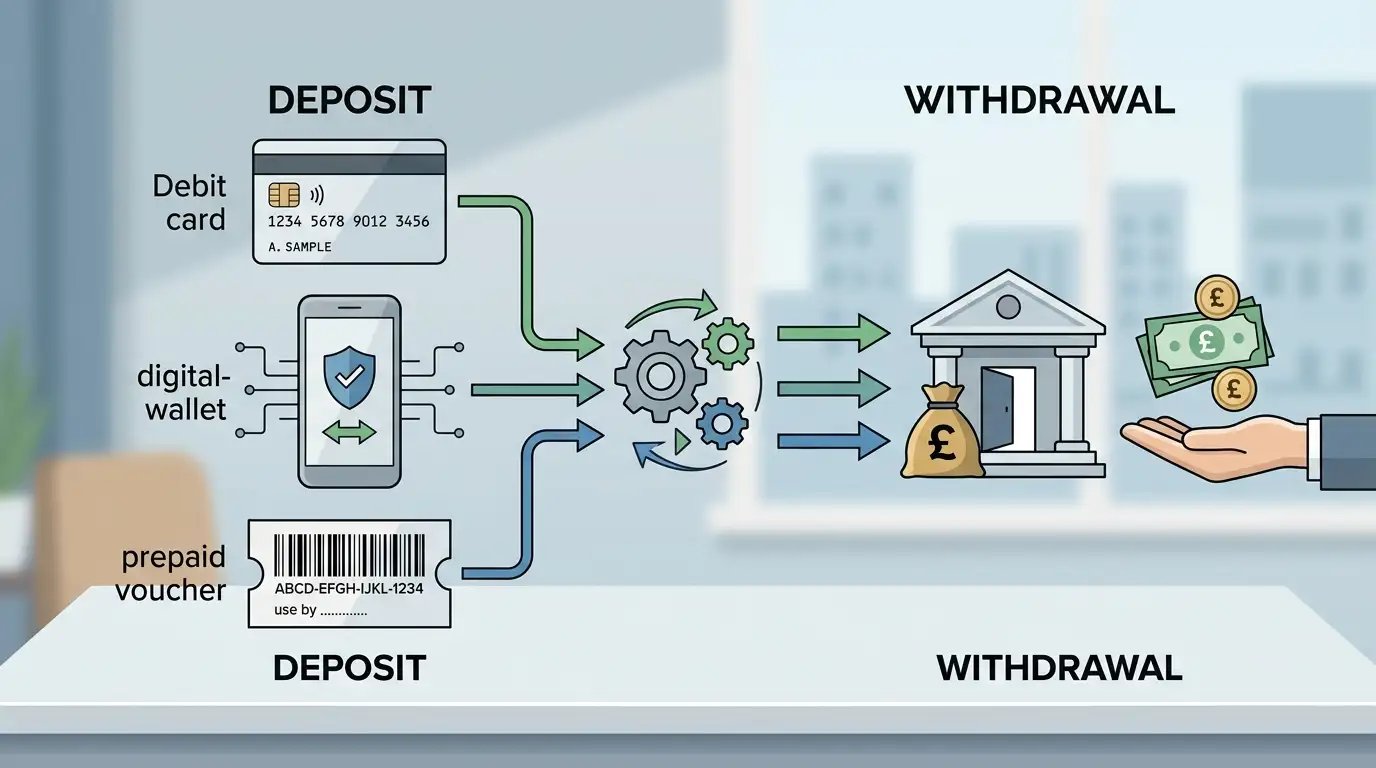
Aspers payment methods at a glance
The available payment information supports a compact banking picture rather than an oversized list. The recurring options are mainstream debit cards, PayPal and Paysafecard, with Maestro appearing across multiple sources. Some recent reviews also list Neteller, but the verified public core is deliberately narrower and more heavily corroborated.
| Method | Deposit support | Withdrawal support in verified core | Verified minimum-deposit signal |
|---|---|---|---|
| Visa debit | Yes | Yes, card withdrawals are listed | £10 in corroborating third-party sources |
| Mastercard debit | Yes | Yes, card withdrawals are listed | £10 in corroborating third-party sources |
| PayPal | Yes | Yes | £20 in corroborating third-party sources |
| Paysafecard | Yes | Not included in the verified withdrawal core | £10 in corroborating third-party sources |
| Maestro | Corroborated | Reported by multiple sources | £10 is reported in one of the corroborating payment reviews |
Multiple sources list £10 minimum deposits for cards and Paysafecard and £20 for PayPal. Payment terms can change, so treat the table as a verified review snapshot rather than a substitute for the current cashier screen.
Visa and Mastercard: debit cards are the key UK context
Cards are the most familiar route for many UK players, but the card type matters. The Aspers payment fact is framed around Visa debit and Mastercard debit. That wording aligns with the Great Britain regulatory environment, where licensed gambling operators cannot accept credit cards for gambling.
The Gambling Commission’s credit-card rule covers online betting, casino and bingo and also prevents operators from accepting gambling payments through money-service businesses when the funds originated from a credit card. The regulator’s current guidance explicitly tells operators accepting e-wallet payments to ensure those wallets do not pass through credit-card-funded gambling money.
This Great Britain rule should not be blurred into a claim about Northern Ireland. The project’s GEO is the United Kingdom, but gambling regulation differs across the UK, so regulatory wording on this page is deliberately labelled Great Britain where that is the regulator’s legal scope.
PayPal at Aspers: why it belongs on the main payments page
PayPal is a verified Aspers deposit method and is also in the verified withdrawal set. That makes it important enough to answer directly here, but not enough to justify a thin standalone PayPal page.
The main practical difference in the approved data is the deposit threshold: third-party sources repeatedly place PayPal at a £20 minimum deposit, compared with £10 for common cards and Paysafecard. That difference can matter if you prefer smaller funding amounts.
PayPal is also relevant to the credit-card rule. The Gambling Commission names PayPal among major e-wallet and e-money providers in its assessment of the Great Britain payment ecosystem, and its guidance says operators must not use an e-wallet route to circumvent the gambling credit-card ban. In other words, “PayPal accepted” does not mean “credit-card gambling permitted through PayPal”.
Paysafecard: useful for deposits, different for cash-out
Paysafecard is part of the verified Aspers deposit set. It suits players who prefer a prepaid funding method rather than linking an everyday bank account directly to the casino cashier. The available payment information also lists a £10 minimum deposit for Paysafecard.
The important decision point is withdrawal compatibility. The verified withdrawal core is Visa/Mastercard and PayPal, while Paysafecard is not included there. That means a deposit method and a withdrawal method should never be assumed to be interchangeable simply because both appear in a cashier review.
If you deposit with a method that cannot receive withdrawals, the operator may need another verified route for cash-out. The exact Aspers workflow should be checked in the current cashier and account terms rather than inferred from generic online-casino practice.
Maestro: corroborated, but not the centre of the cashier
Maestro is repeatedly listed in Aspers payment profiles and is therefore safe to mention as a corroborated option. It is less important to the page than Visa debit, Mastercard debit and PayPal because the verified payment evidence is built around those more consistently reported routes.
This is a useful example of evidence weighting. A payment page does not need to turn every historical or secondary method into an equal headline feature. The goal is to show the best-supported set first, then identify additional corroborated methods without pretending that the cashier is static.
Deposit support and withdrawal support are different facts
One of the easiest mistakes in casino payment reviews is to list a logo once and imply that it works in both directions. Those questions need to be checked separately. Visa debit, Mastercard debit, PayPal and Paysafecard are supported for deposits, with Maestro corroborated. The verified core for withdrawals is Visa/Mastercard and PayPal.
That split matters because deposit-only methods can create an extra step later. It also explains why this page does not publish a blanket statement such as “all methods support withdrawals”. Even when a third-party review says a method supports cash-out, the current cashier can still impose account-specific or payment-network restrictions.
If withdrawals are the main reason you are researching Aspers, use the dedicated withdrawal guide. It separates the verified cash-out routes from exact fee, limit and timing claims that require current primary confirmation.
Why exact withdrawal times and limits are omitted here
Third-party pages contain several precise claims about pending periods, instant wallets, card processing times and withdrawal limits. They do not agree consistently, so those numbers should not be treated as settled current terms. Exact current Aspers withdrawal limits, fees and processing times are not primary-source verified, so this page does not publish them as fixed values.
This is different from the payment-method list. A method can be verified by repeated independent listings, while an exact cash-out time can depend on operator review, payment rail, bank processing, account verification and the current terms. Treating those fact types as equally stable would make the page look more precise while actually making it less reliable.
For the same reason, this page does not promise that a PayPal withdrawal is instant or that a card withdrawal will always arrive within a specific number of business days. Check the current cashier for method-specific timing before relying on it.
GBP and the Great Britain payment environment
The site is written for UK readers and uses GBP as its working currency context. The broader market also helps explain why debit-card compatibility matters. The Gambling Commission states that the vast majority of remote gambling deposits are made by debit cards in Great Britain. That is a market-level observation, not an Aspers-specific statistic.
The same regulatory assessment names major e-wallet providers including PayPal, Skrill, Neteller and Revolut. Their presence in the wider Great Britain ecosystem does not mean every operator supports each one. Operator-level availability still has to be established separately, which is why this page only attributes Aspers support to the methods supported by the information used for this guide.
That distinction helps prevent a common review error: taking a popular UK payment method and assuming it must appear at a specific casino. Popularity and operator support are separate evidence questions.
KYC and account-name matching: what to expect without inventing documents
Payment processing can intersect with identity and account verification, particularly around withdrawals. Verification requirements can matter, but no reliable current source here supports publishing a definitive Aspers document checklist or exact verification time.
Practically, use payment accounts in your own name and keep your account details consistent. If the operator requests verification, follow the current instructions shown in the account area. The separate Aspers registration and KYC explains this distinction in more detail without inventing a fixed document set.
Payment reversals and method switching
A banking page should also distinguish technical payment support from account-level transaction decisions. A failed deposit, reversed card transaction or unavailable withdrawal route does not necessarily mean the method is unsupported across the platform. Banks, wallets and payment processors can decline or reverse transactions for their own reasons.
If a method fails, do not immediately cycle through multiple alternatives without checking the account message. Repeated attempts can complicate transaction history. Confirm whether the issue sits with the operator, the payment provider or your bank, then choose another verified method only when necessary.
Similarly, depositing by one route and expecting to withdraw through an unrelated route can trigger extra checks. The current cashier should be treated as the operational source for what your account can use at that moment.
How to choose between debit card, PayPal and prepaid funding
- Choose debit card when:
- You want a familiar bank-linked method, the £10 minimum-deposit signal fits your budget, and your bank permits the gambling transaction.
- Choose PayPal when:
- You prefer an e-wallet layer and are comfortable with the higher £20 minimum-deposit signal in the verified Aspers sources.
- Choose Paysafecard when:
- You value prepaid funding and understand that the deposit method is not part of the verified core withdrawal set.
- Consider Maestro when:
- Your account and current cashier still offer it; it is corroborated, but it is not the central method in the verified payment evidence.
Whichever method you choose, decide the amount first. A cashier should implement your budget, not define it. If you are using a promotion, also check whether the deposit method has any verified bonus eligibility condition on the Aspers bonus rather than assuming all funding methods are treated identically.
A practical cashier checklist
- Confirm the method is visible in the current cashier before funding.
- Check whether it supports deposits only or also withdrawals.
- Compare the current minimum deposit with your intended budget.
- Use a payment account in your own name where required by the operator.
- Read the current withdrawal information rather than relying on old speed or fee claims.
- In Great Britain, do not expect credit-card gambling or a credit-card-funded e-wallet route from a licensed operator.
- If a bonus matters, verify payment-method eligibility separately from ordinary cashier support.
Verdict: simple method mix, but keep cash-out claims separate
Aspers has a conventional payment core: Visa debit, Mastercard debit, PayPal and Paysafecard for deposits, with Maestro additionally corroborated. Visa/Mastercard and PayPal form the verified withdrawal core. The repeated minimum-deposit signal is £10 for cards and Paysafecard and £20 for PayPal.
For Great Britain, the regulatory context is equally clear: credit-card gambling is prohibited for operators within the UKGC licensing regime, including indirect credit-card funding through e-wallets. Debit cards dominate remote gambling deposits across the market, while PayPal is one of the major e-wallets recognised in the regulator’s payments analysis.
The key limitation is precision around cash-out mechanics. Exact Aspers withdrawal times, fees and limits are not established well enough here to publish as fixed figures, so check the current cashier or terms before relying on them. For the wider brand picture, return to the Aspers Casino review.
Frequently asked questions
Does Aspers accept PayPal?
Yes. PayPal is verified for deposits and is also included in the verified withdrawal method set.
What is the minimum deposit at Aspers?
Multiple third-party sources list £10 for cards and Paysafecard and £20 for PayPal. Payment terms can change, so confirm the current cashier value before depositing.
Can I deposit with a credit card?
For operators serving customers under the Great Britain licensing regime, Gambling Commission rules prohibit credit-card gambling, including credit-card-funded payments through e-wallets. This regulatory statement should be read as a Great Britain market rule, not as an operator-specific payment feature.
Can I withdraw with Paysafecard?
Paysafecard is verified as a deposit method but is not part of the project’s verified core withdrawal set. Check the current cashier for the available cash-out route on your account.
How long do Aspers withdrawals take?
This guide does not publish a fixed current processing time because the exact timing claims in secondary sources are not primary-source verified and do not agree consistently.
Aspers Casino Payment Methods: Deposits, PayPal and GBP Banking
Content created by the «Aspers» team